Trumbull Co. ranks 4th for vehicle-deer collisions

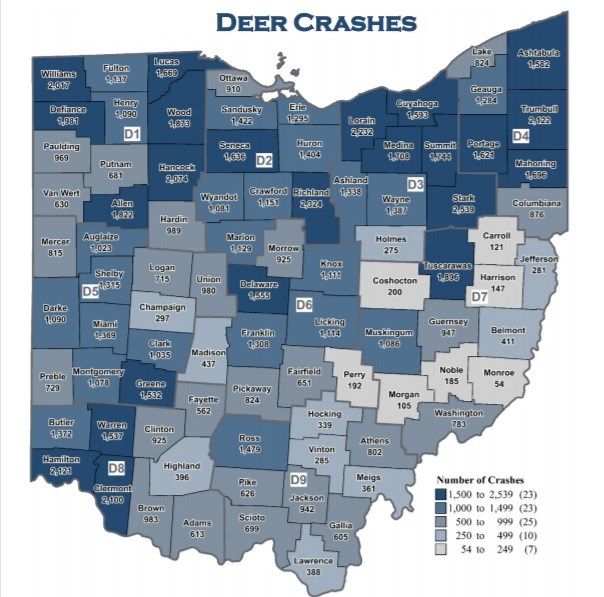
COLUMBUS, Ohio - As drivers are being reminded that this is the season to watch out for deer crossing highways this time, officials in Ohio note that Trumbull County has the fourth-highest rate of deer-involved crashes in recent years.
From 2015 to 2019, Trumbull County recorded 2,122 accidents involving deer. Only Stark, Richland, and Lorain counties reported more deer-involved crashes during the period.
There were 1,696 such accidents in Mahoning County and 876 in Columbiana County.
Nearly half of deer-involved crashes occurred during the months of October, November, and December. More than one in five crashes happened in November alone.
The dawn and dusk hours are the most likely times for deer-involved crashes.
US Route 30, Interstate 80, and I-71 are among the top three highways for accidents involving deer.
In 2019, statistics from the Ohio State Highway Patrol show there were 19,375 deer-related crashes on Ohio's roadways. Of those crashes, four resulted in fatal injuries to motorists, and 966 people were injured.
"Always avoid distractions and keep your full focus on the roadway," said Colonel Richard Fambro of the Ohio State Highway Patrol. "If you see a deer slow down, but do not swerve. If you strike a deer, move to a safe place if you are able, turn on your hazard lights, and report the crash."
According to the Ohio Department of Natural Resources (ODNR), deer become much more active during the fall breeding season which occurs from late October through November.
Recent data estimates the average insurance claim for a deer-vehicle collision in Ohio is nearly $4,000. Vehicle sensors found on newer vehicles continue to increase repair costs. AAA found these new safety systems can double repair bills for minor collisions.
AAA and the Ohio Department of Insurance remind drivers that the optional comprehensive coverage (also known as "other than collision" coverage) portion of an auto insurance policy often is used to pay for deer-vehicle damage repair. Collision or liability-only policies do not cover the damage. With the vast number of costly deer-collisions on Ohio's roads, it is often a good idea to maintain comprehensive coverage, even with older vehicles.
How to avoid animal collisions:
Scan the road ahead: Looking ahead helps provide enough reaction time if an animal is spotted. Also, remember some animals, like deer, move in groups, so when there is one, there are usually more in the area.
Use high beam headlights if there is no oncoming traffic: This can help you spot deer or other wildlife more quickly and give you time to slow down, move over or honk the horn to scare the animal away. High beams also help in spotting animals' reflective eyes.
Be extra cautious at dawn and dusk: Deer tend to be more active in the early morning and at dusk. That's why these are peak times for deer-vehicle collisions.
If a collision is unavoidable, apply the brakes firmly and remain in your lane: Swerving to avoid an animal can often cause a more serious crash or cause you to lose control of your vehicle. Drivers who swerve to miss a deer and hit something else may be charged for an at-fault crash.
Always wear a seatbelt and remain awake, alert, and sober: The chances of getting injured when hitting an animal are much higher if you don't have your seatbelt on. If you're distracted or drowsy, you're not properly scanning the road for deer and could end up spotting them too late.
What to do if you hit a deer:
- Following the collision, call the police.
- Avoid making contact with the deer/animal. A frightened and wounded animal can be dangerous and pose a threat when approached or might further injure itself.
- Activate the vehicle's hazard lights whether it's light or dark outside.
- If possible, move the vehicle to a safe location out of the roadway, and wait for help to arrive.
- Drivers should contact their insurance agent or company representative as quickly as possible to report any vehicle damage.