
Carfentanil cases rise in Ohio

COLUMBUS, Ohio - The number of drug samples containing the synthetic opioid carfentanil has risen across Ohio through the first three quarters of 2025, according to data from the Ohio Bureau of Criminal Investigation (BCI), with confirmed cases in Mahoning and Trumbull Counties.
BCI forensic scientists identified carfentanil in 199 items submitted for testing statewide during this period. The data map shows Mahoning County recorded four reported carfentanil cases, while Trumbull County recorded two.
The 199 items confirmed to contain the drug so far this year come from 46 counties. Franklin County had the highest number of reported cases with 31, followed by Delaware County with 17 and Fairfield County with 13.
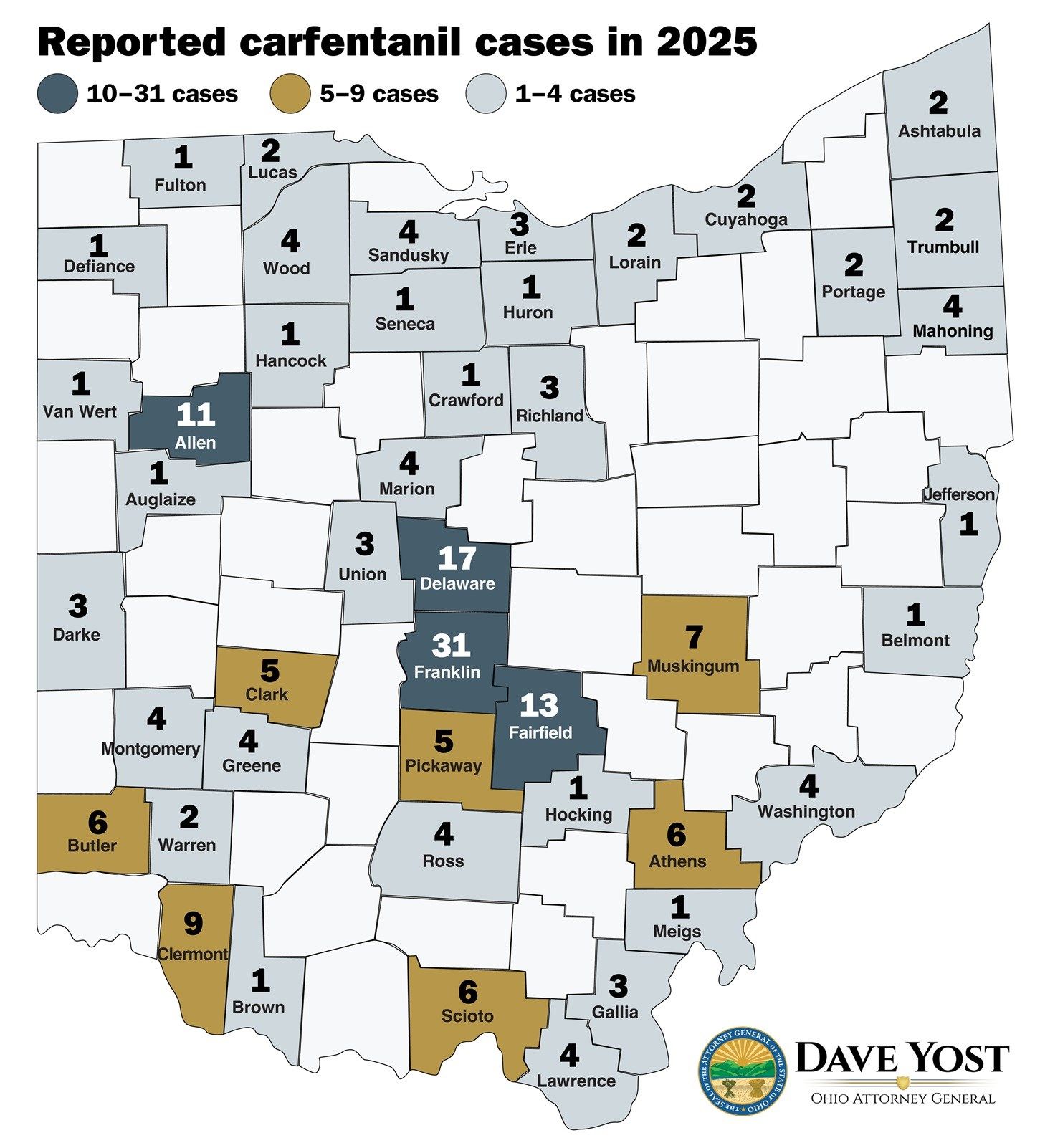
Ohio Attorney General Dave Yost urged the public to be cautious regarding illegally obtained drugs.
“The amateur chemists who create these deadly drug combinations don’t care if you live or die,” Yost said. “Here’s the deal: If you take drugs that weren’t prescribed by your doctor, you risk lethal exposure to synthetic opioids.”
Carfentanil, which is not approved for human use, is approximately 100 times more potent than fentanyl. Its presence in Ohio had decreased sharply after peaking in 2017, when BCI identified it in 1,119 drug samples. Confirmed cases totaled nine in 2023 and 40 in 2024 before the current uptick.
The drug, used by veterinarians to anesthetize large animals, can be found alone or mixed with other substances, including fentanyl, heroin, and cocaine.
In addition to the rise in carfentanil, the BCI lab recently identified a new opioid compound in Ohio, N-propionitrile chlorphine, also known as cychlorphine. The substance was seized at the scene of a non-fatal overdose in the Butler County city of Fairfield and also contained fentanyl and xylazine. First responders reported that multiple doses of Narcan were required to revive the individual.
N-propionitrile chlorphine is an emerging synthetic opioid that BCI has not frequently identified in seized drug samples in the state. The BCI lab has evaluated approximately 65 distinct fentanyl compounds to date.
